The Engineering Behind YouTube's Bell Icon
Why the YouTube bell isn't just a notification preference — it's a load-shedding switch between fan-out-on-write and fan-out-on-read at platform scale.
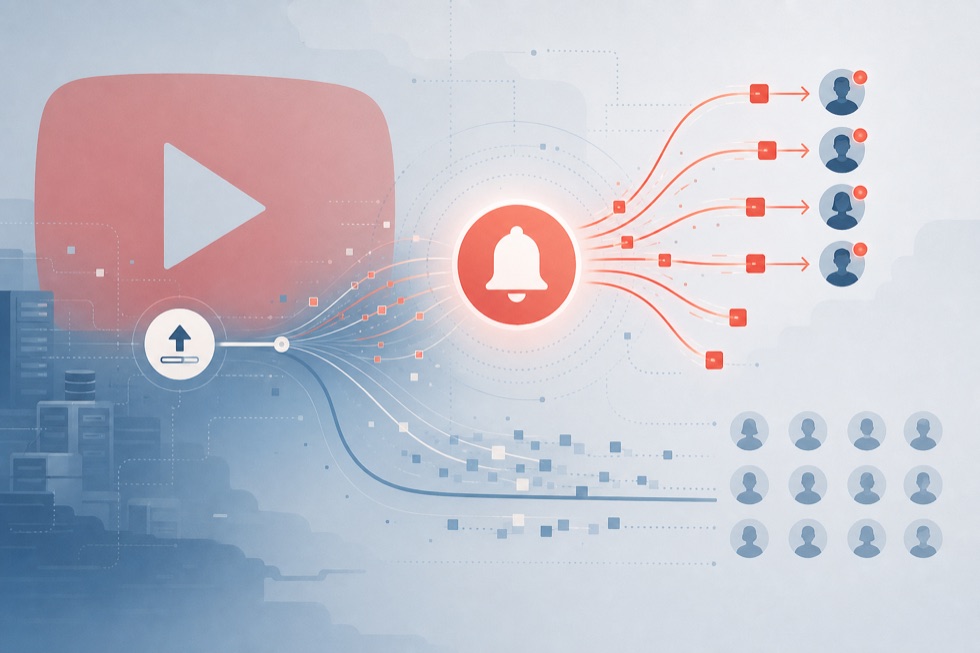
Most people think the YouTube bell icon exists to fight the algorithm. Subscribe to a channel, and you're still not guaranteed to see every upload, so the bell is your way of saying "no really, tell me the second this drops."
That's true. But it's not the interesting part.
The interesting part is why YouTube didn't just notify all subscribers by default. And the answer is pure infrastructure economics.
Do the math on a single upload
Take a channel with 100 million subscribers. Now imagine every upload triggers a push notification to all of them, instantly.
That's 100 million notification payloads generated in one shot. Each one has to route through APNs or FCM, both of which throttle traffic per app. Each one needs a row written somewhere to track delivered, read, clicked. And this isn't a one-time cost — it repeats every time any large channel uploads, potentially dozens of times a day across the platform.
This is what's called fan-out-on-write. The system pays the full cost of distribution at the moment of the write, whether or not anyone ever opens the notification. It's the most expensive way to move data at scale, and YouTube would be doing it constantly if it applied to every subscriber by default.
The alternative: fan-out-on-read
Compare that to how your home feed and subscription feed actually work. Nothing gets pushed to you the moment a video uploads. Instead, the system computes what to show you lazily, only when you open the app. Cheap to write, more expensive to compute at read time, but that cost only gets paid when a user actually shows up.
This tradeoff — eager write vs lazy read — shows up everywhere in distributed systems. Twitter's engineering team wrote about this exact problem years ago. They don't fan out tweets from celebrity accounts to every follower's timeline at write time either. They special-case it and merge results at read time, because doing it eagerly for a million-follower account would hammer the system on every single tweet.
So what does the bell actually do?
It's a pre-filter on the fan-out set.
Instead of eagerly pushing to everyone, YouTube only pays the expensive fan-out-on-write cost for the subset of users who explicitly opted in by hitting the bell. Everyone else stays on the cheap, lazy, algorithmically ranked path.
You're not choosing between "notified" and "not notified." You're choosing between two completely different delivery architectures, and the bell is the switch that moves you from the cheap one to the expensive one.
Why this matters beyond YouTube
A few second-order effects fall out of this design almost for free:
- Push gateways like FCM and APNs throttle bursty traffic. Gating the eager set keeps you from tripping those limits during a viral upload.
- The bell click itself becomes a strong intent signal — more reliable than the subscribe action, which people do and then forget about. That's useful downstream for ranking and recommendations.
- Every push notification needs idempotency and retry handling. Shrinking the eager set by even one order of magnitude meaningfully cuts your ops surface.
None of this is about engagement psychology, even though "smash that bell" gets sold that way. Under the hood, it's the same shape as hot partition mitigation or selective replication in any large distributed system: you can't treat every write path as equally cheap, so you build a cheap default and let users opt into the expensive one.
The bell icon is a load-shedding mechanism wearing a UI costume.